Listen to the podcast on:


Snag 1 of only 12
VIP weeks in 2026
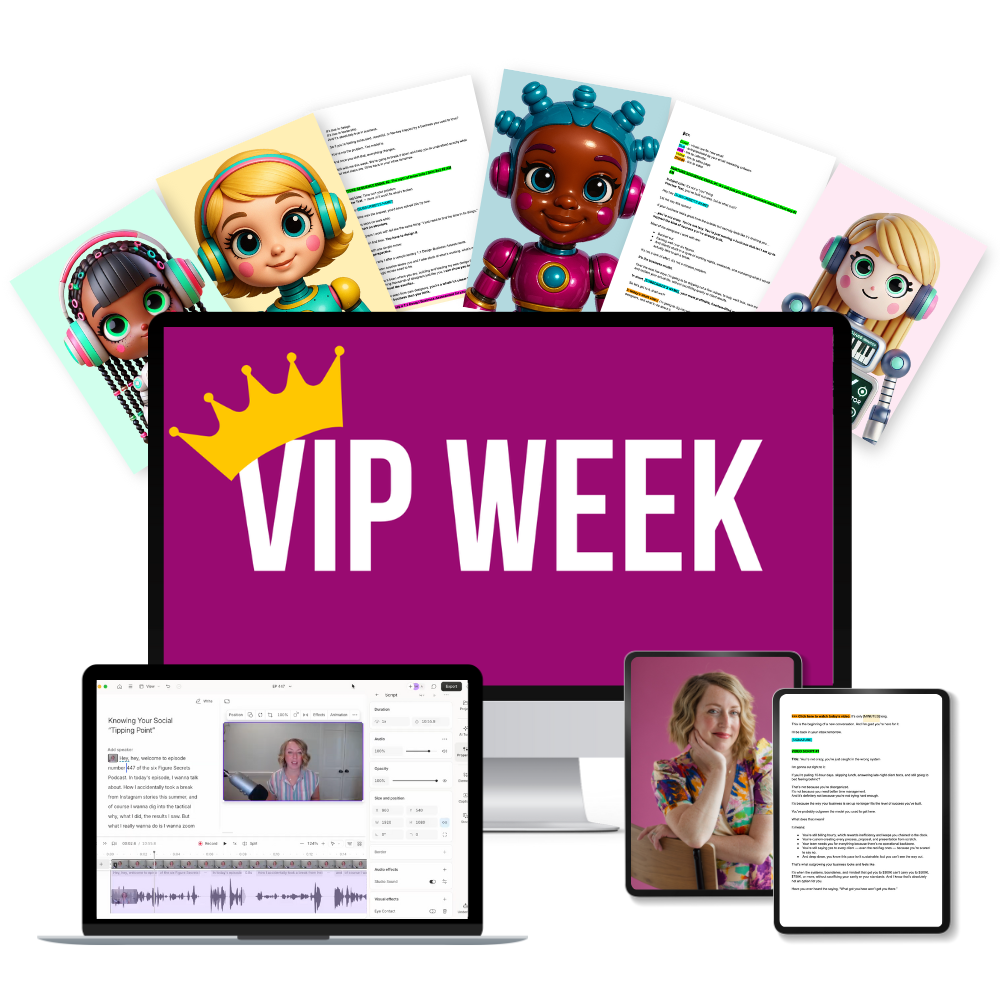
Snag 1 of only 12 VIP Weeks in 2026. VIP Week is a high-touch, Monday–Monday intensive where we build your email funnel the right way — with strategy first, and sales baked in from the start.
Ever feel like you’re stuck on the content treadmill, endlessly creating content, only to feed the social media algorithm.
In this Empire Exclusive episode, Jana Osofsky reveals her Capsule Blog System: A high-converting, blog strategy that fuels her entire email marketing engine.
In her interview, Jana walks you through how she turns 12–20 evergreen blog posts into repeatable, repurposable gold, and how her system fuels her email to guide subscribers toward sales, without treating nurture and sales like they're two entirely separate things.
TAKEAWAYS:
Evergreen blog content is the foundation of Jana’s email marketing strategy and she reuses it weekly to build trust and drive sales.
Jana doesn't silo nurture and sales emails. Every email can do both, when written with intention.
Jana sends 2–3 emails per week from her capsule blog library and isn’t afraid to email a lot during a launch (think: 8+ per day!).
Specificity sells. Jana writes highly targeted emails to answer objections and speak directly to her audience’s pain points, often in series that are closely sent out one after another.
Jana chalks her email success up to knowing what season of business you're in and aligning your CTAs to move your subscribers in that direction.
Resources:
Sign up for Jana's High Level Hits email series
Snag 1 of only 12 VIP Weeks in 2026. VIP Week is a high-touch, Monday–Monday intensive where we build your email funnel the right way — with strategy first, and sales baked in from the start.
Know you need email marketing support, but not sure what offer works best for you? Fill out this form, and Allison will be back in your inbox with a few options that fit you, your business, and your budget best.
CONNECT WITH ALLISON:
Follow Allison on Instagram
DID YOU HAVE AN 'AH-HA MOMENT' WHILE LISTENING TO THIS EPISODE?
If you found value and are ready to take action from listening to this episode, head to Apple Podcasts and help us reach new audiences by giving the podcast a rating and a review.
Music by: www.bensound.com
License code: 8G1GJZZDCLKGU9NR
Artist: : Benjamin Tissot
🤔 Want to work together?
Here’s how to get started!

Join the email marketing membership for coaches and experts, who want to sell their offer on autopilot.
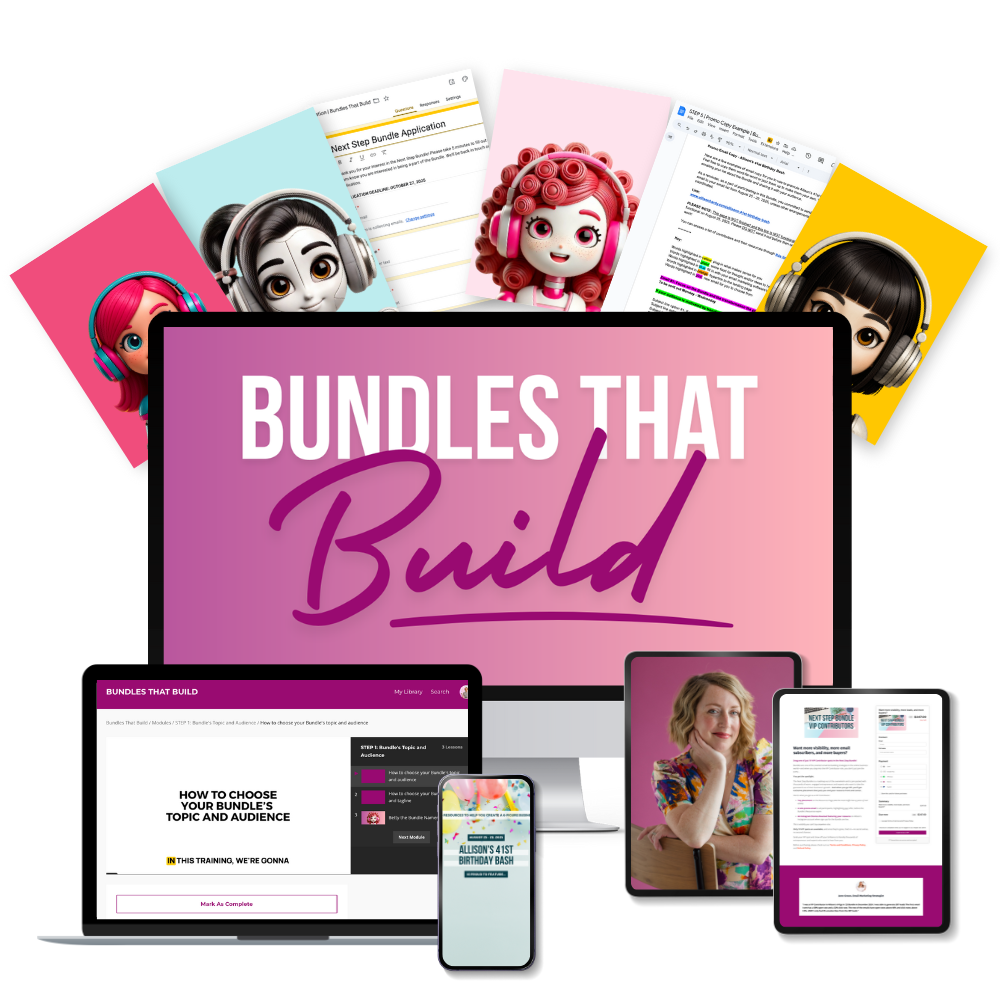
Host a bundle that builds your email list, your visibility, and your sales.
🤷♀️
Know you need email marketing support but not sure what offer fits you, your business, or your budget best? Click the yellow button and fill out a quick form. Allison will be back in your inbox with a few options and suggestions for you.
Transcript:
Hey Jana. Welcome to the podcast. I'm so excited to have you. I'm so excited to be here. Thank you for having me. I'm thrilled to have you. I know a ton about your business, but I know our people probably don't. So can you share with our listeners a little bit more about you? Your business, who you serve, and how you serve them? I've been in business for about nine years. I'm a content strategist. I also spent a lot of those nine years, especially early on doing done for you Pinterest marketing setups and done for you blog strategy and writing. I had a retainer client during a lot of those early years for about five years where I was doing all her content strategy and Pinterest as well.
A few years ago I decided to create the content strategy course that everyone had been asking me for years. So, I run a program now called High Leverage Content. It's been around, like I said, for a few years now, and I teach a capsule blog. Strategy where we create a capsule blog of 12 to 20 blog posts that cover the key things that your audience needs from you to feel ready to buy.
And then we leverage those blog posts on repeat to get clients. So it's basically a capsule blog plus repurposing program. And, um, yeah, so that's me, content strategy, Pinterest, and then these days running this program, helping people do those things in their business. What types of businesses do you generally work with?
I have a lot of health coaches, a lot of other types of B2C coaches in my program. A lot of life coaches, people who are really expert at what they do, and are still kind of getting, good at the marketing part of things. I also have a lot of health and wellness practitioners in my program too, so people who are like chiropractors and acupuncture folks.
Then I also have a lot of service providers done for you, service providers, and done with you service providers, people like website designers, brand designers, email marketing strategists. I feel like I'm missing a big, a big one. Social media managers, Pinterest managers, and I think a lot of the reason why a lot of those folks gravitate towards me is because the system that I created that I now teach to my students was the system I used in my own business during those years where I was a done for users provider.
So, it's a kind of a proven system that works for this kind of business too. So those are kinda like the two types of people that I have mostly in my program. So the, the short version of that is coaches and service providers. I love it and I think it's cool. I always think it's really cool when you can teach the people that you were so like you were a done for you service provider, and now one of your ideal clients is done for you service providers.
It helps you to just like. You get it. You're like, I understand where you're at. Yeah. I can help you. And it makes the program even better, so, yeah. Very cool. So now that we know a little bit more about you and your phenomenal business and how you help people, I'd love to shift to talking about email.
Mm-hmm. So here on these Empire exclusive episodes, really dig into how you're utilizing email in your business. So from what I know about you and your business, everything stems from your capsule blog library system. So can you first share. More about what that is. Yeah, yeah, for sure. So the capsule blog library goes on your own blog.
It's on your own website and as I mentioned, it is 12 to 20 blog posts that cover all the key things that your audience needs to feel ready to buy. So the first thing that we do in the program is figuring out what those things are, right? And there's a whole process to doing that.
And then writing those blog posts in a way where there's, I have outlines where we structure them in a way that are high converting. So when you have a capsule blog library, yes. People go and they read the blog posts. Yes. People do buy from the blog post. Sometimes it happens all the time For me, it happens for my students.
But the other big benefit of having a capsule blog library is that you have, it's like the source of truth for your business. It has all your main messages. It's long form. So they're all there with all the details that people need to really. Feel like that they, they build trust and they build desire for your offers, and then you can repurpose and leverage and use those long form pieces of content in all different other places in your marketing.
I call that all up and down your marketing is what I say. So it's like, first we figure out what your audience needs to feel ready to buy, then we write those blog posts and then we use them all up and down your business to get clients. A lot of what that is, is repurposing from those blog posts, right.
And so one of the places where I repurpose in my business from my own capsule blog, just like I teach my students, is in my email marketing. Email marketing is super important to my business, first of all, so I can't, I'm so excited we're talking about it. And the first kind of layer of email marketing strategy for me is making sure that my capsule blog library is informing what I would consider like my foundational, like baseline for what I'm always sending out to my email list.
So one of the ways I wanna use my email list and communicate with my email list is making sure that I am regularly repeating all of the main messages from my capsule library. One of the great things about a capsule library is when you repeat those main messages regularly, you become known.
You build trust. Repetition is really where it's at when it comes to making sales, right? We can have that whole conversation, but hopefully we're all on the same page about that. And so when you're repeating from your blog, to your email list like that, you wanna be doing that essentially. And so that's like kind of the first layer of my own email marketing strategy.
I'm making sure that I'm regularly sharing my blog posts, pulling gems out of my blog posts to create, what I call, I don't really like to call it nurture content, but it's more like trust building content, demand building content, desire, building content that's going out to my email list in the form of emails.
So that's pretty much like the way I'm leveraging my blog. And then I have other kind of like aspects of my email marketing strategy as well. Okay, so the blog informs basically the content that you're sharing in your email marketing. Yeah. What I would say is like the foundational content. Yeah. Mm-hmm.
And the reason I say that, that way, foundational content, not all the content is because I also have other parts of the strategy. So I'm also sending lots of sales emails, for example, and some of those are based on. Things that I've talked about already in my blogs, and I'm pulling from my blogs to create sales emails and other sales emails or sales emails that I am writing, just writing a sales email.
So when it comes to the, like trust building content Yeah. Can we talk about when you're sending that out? Sure. Yeah. The real answer to it is all the time because I feel like, I don't consider my marketing or my emails to be like in silos.
I'm not like, okay, this is a nurture email and then this is a sales email. Mm-hmm. Like, they're not separate. We're doing both at the same time. And everything I know about the way you email, 'cause I watch your emails very closely as well, Alison. I think that you believe that as well. It's not like, you know, we're doing them in separate silos at separate times.
You don't have to nurture three times in order to earn your, your place in asking for the sale. We're always asking for the sale and always pre-selling and selling. Um, but I would say that I, in terms of the emails that I'm deriving directly from my blog, I'm sending those, at least twice a week in my business.
I would say sometimes three times a week. So that can look like me doing a teaser where I write a little bit about why I wrote the blog post, or I use the introduction from the blog post and then linking to the blog post, which remember. Is something my audience needs to feel ready to buy and it's structured in a high converting way 'cause that's how I roll.
Or it could mean pulling something out of a blog and sharing that as a standalone piece of content with any call to action that I would like to have, including things like buy the thing, sign up for something, send me a message back. Let me know, you know, reply back, any of those CTAs that we use in our emails.
But I'd say like two to three times a week is, an email that's derived directly from a blog post. Okay, so I, I just love your, that you just dig into this. So you're having, you're having emails that are driving traffic to the blog post? Mm-hmm. Awesome. Great. Wonderful. And the goal there is to get them to read the blog post and then do whatever the call to action is inside the blog post.
Usually buy something. Yep. And then on the other side of this, you're taking the content from the blog posts, making standalone emails from them. Yeah. Which then also drives to other places. So like, buy the thing, sign up for this thing, hit reply and let me know the question. Fill out this form, whatever it is exactly.
Oh, so good. Do you find that, so how did, so let me ask this. So with those call to actions. How did you start to figure out that system? How do you know when to say call to action, number one, versus call to action Number four. I think it usually depends on what is going, like what season of business I'm in, if I'm currently getting ready for a launch.
If I'm currently in driving mode for a launch, if I'm currently launching, or if my doors are closed, then I just finished a launch. So every week in my content calendar, I have a note in one of the columns of my weekly content calendar that talks about what we're working on that week.
If I'm leading up to a launch, I might be asking more questions of people to reply back because I'm trying to get more engagement going and honestly create that algorithmic favor as well because our ESPs like it, our email service providers and our deliverability. Likes it.
Let's personify that. Yeah. When people are replying back and answering questions. Right. So it's really gonna depend on what my priorities are right now in my business during this week and during this month, in terms of what I'm asking people to do as the CTA. Does that make sense? Yes.
And I wanted you to say that because I wanna reiterate this to our listeners. You need to know where you're going with your marketing, right? So just willy nilly emails. Yeah. You're not gonna get. The results you want from it, because there's no point to it. You need to have a clear focus, as to what's going on in your business when, and then everything goes towards that goal, whatever that goal is that week.
Right? So I love that you just said that because you explained it so well and so clear and, I think that a lot of folks in the online space don't have that sort of focus or that sort of like, yes, they don't know the schedule. Yes. Yes. So it's really hard to get somewhere when you don't know where you're going.
Yes, yes. And interestingly, and we can circle back to this because I send a lot of emails and we've talked about that, and then we'll talk about it, I'm sure. But people always ask me like, oh, are you worried people are gonna unsubscribe? And that's a whole conversation, right? And we can have it. But I've noticed that if there's a week or a month where I am less focused on what I'm asking people to do, that's when I get the unsubscribes, not when I'm sending a bunch of emails that are super duper clear about what's going on.
What they can be doing to solve problems. What I want them to do next. It's when I send out random stuff that doesn't have any kind of like, it's just like my musings not, I don't mean like totally random, but like random musings on content strategy or random musings on business. That's when people are like.
What is this woman trying to get me to do? Unsubscribe, you know? So you really do have to be focused, and I think if you're not, that's when you actually lose your people. Really. You lose their attention. Yes. I so agree. And I find that too. Mm-hmm. When I'm like, I don't know, like let's say the summer, I'm not as structured as I normally am in the summer.
I, I'll send something out and people are like, unsubscribe, like what is right? What is she like, what is the point of this? Right? And it could even be like a super, really interesting email about something that does make a really good point. I'm not saying that I'm like talking about something super random, like my dog at the beach or whatever.
I'm just saying. If you aren't like leading them down a very specific path and they don't feel like they're moving towards a solution to something they want through your content, they're like, okay. Yeah, no, and I think that's one of the reasons why, like there are some of those email marketing memberships out there who are just like, every week they tell you, like today, like email randomly about this, and then tomorrow email randomly about that and whatnot.
And um, those are kind of, I think good for like flexing your consistency muscles, but they're not really good for getting people to actually do the things you want them to do and buy your thing. So. People came to you for a very specific reason. They're looking to solve a pain point. So when we deviate from that, it's not helpful to them.
And that goes back to your original statement of everything should have a goal. Everything should be intentional. I do wanna talk about your, cadence of emails because I am on your email list. I watch your emails 'cause I enjoy them.
Okay. But I do have like a very specific question. I have noticed, when doors are open to high leverage content mm-hmm. You will send out an email, like two emails, like 30 minutes from each other. Mm-hmm. Why do you do that? Typically when I'm doing my launch emails, my, email scheduling assistant, like I write the emails and she schedules them and we usually are scheduling them about an hour apart. And on some launch days, I am sending, get ready for this, up to eight, sometimes even 10 emails.
Love it. People do love it. My buyers love it. My audience loves it. So anyone who's listening and thinking like, I wouldn't, I would unsubscribe. Like, that's fine. You can, but if it's relevant for you and you feel like it's moving toward the solution to a problem you have and stuff, then you won't.
And the reason I know this, ask me how I know this. It's because people don't, and they buy from me this way. My point is, is that on those days, I'm sending emails very close together. I guess it could be a half an hour sometimes. And I'm doing that for a couple reasons. Mostly it's because I wanna send a lot of emails because I want my emails to answer all the specific questions and talk about all the specific scenarios.
I don't wanna go wide with my emails and really be general. I wanna be very specific and in order to be able to cover. All the individual questions, and then also, let's say you have a question. I wanna be able to answer that question as it relates to you as a health coach. I wanna be able to answer that question as it relates to you as a.
Service provider, like a web designer. So that's gonna require two different emails. So overall, I'm just sending a lot of emails to cover a lot of things because the more emails I send and answer the real questions that are on people's minds and solve their real problems, the more, they feel confident with their buying decision.
Because it, when you're in a launch, really all your emails should be really driving to help people feel confident in their buying decisions so that they really feel like they know what they're buying, they know what they're getting, they know why they're buying it. They know what you're promising them.
And they know, you know, if there's concerns or objections, they know how you feel about or like what your response is for them in their particular situation. And that requires a lot of emails. And so sending them out close together is simply because there's only so many hours in a day and I'm sending out emails all throughout the day.
The other reason sometimes I send them back to back like that, whether it's in a launch or not, is because it gets people's attention in a new way. Our email boxes are so full of things. I definitely for sure know that that's true. And so if they get four emails in a row from me or five emails in a row from me on a day, it's hard to ignore that.
And so as long as those emails are helpful and the subject lines are showing them that, Hey, this is for you and you're gonna wanna read this. And they get those emails from me, it's gonna be like they're gonna notice it and they're gonna look at those subject lines and decide if they wanna open them based on what I'm talking about in the email.
And that's what I want. I don't want my emails to be lost in the sauce kind of thing. And I like to use that technique for certain situations in particular. One of them is case studies. I like to send out like five emails in a row that are all case studies and have them hit the inbox. Like every hour on the hour, for example.
Or maybe I did do a half an hour, I don't know. And that way, like if someone, if the average person, let's say, checks their email three or four times a day, let's say, right? Mm-hmm. When they go in to check their email. At like four o'clock or whatever, they will have received like four emails in a row or five emails in a row from me that are all case studies.
So it'll be like, all the names of my client, like my students who achieved certain things essentially. So it'll be like, you know, Lucy went from this to that. Adam was able to X before he did this without having to do that or something. Right? So it's like all in a row with their names and it creates this sense of like.
If some of my buyers will read all those emails and love them all, some of them will just see the subject lines and think, oh, she gets real results in her program. Yeah. Right. And then I also sometimes do it in a series. So I'll have like three emails in a row that are like, I don't like writing.
How can I have a blog? Or, I love writing my blog, but it's not converting. So it'll be like three in a row that are all related to each other, but are like different versions of the same question or opposite sides of the coin of a question. And my audience loves those as well. They eat those right up. So if you're seeing them all in a row from me, it's usually because I'm launching and I'm just sending a lot of emails.
Yeah. Or because I purposely wanted to get people's attention by having multiple emails all in a row and send a message to them that even if they don't open the emails, i'm getting results in my program for all these people, these five names that you see specifically or this program will work for you even if you're not a good writer.
This program will work for you if you love writing, but it's not converting. This program will work for you if you don't know what to write. So it's like three things in a row that are kind of all related to each other. It's what I would call a series of sales emails. Yeah. No, I will.
I love it. And I was like, there has to be a strategy behind it. And I thought that's what it was, but I wasn't sure. But it reminds me of. When I first started doing master classes, I had this coach that was like, you need to do master classes, like every week you gotta do this master class.
And I was like, okay, let's get real crazy and do that. But she said to me, she was like, the longer you stay on and the more questions you answer, the more sales you'll make. So she really encouraged me at the end of the masterclass to have this session where you just answered all the questions.
And it reminds me of that because Yep. It's the exact same philosophy you just applied to email a hundred percent. Exactly, yes. How did you like land on that? Like what was the, like, did something happen where you're like, oh, I just need to send more emails? Like how did you land on that method of execution?
I mean, I've been in email marketing programs that encouraged you to have a really good mindset about sales messages and basically just encourage you to be like. There's no maximum number of emails that you can send, just like there's no maximum number of questions you can answer at the end of a webinar.
Exactly. Just like there's no maximum number of times you can post on your social media channel. And the more you post and send, if it's good quality content, and it's actually getting to the things people want to read about. And of course that's always the caveat, the more you're gonna create that trust, help people know what they're buying, help people understand the granular problems that your offer solves, and just the more sales you're gonna make.
So I think that I landed on it that way and just realizing that, hey, when I answer someone's really specific question. They feel good about buying and then they buy. Look at that. Look at what just happened. And so how can I do that more at scale? I remember you taught me something a while back, about, and I do this and I know a lot of people do in their business where I get a lot of questions back via email, and then I send them back the email that answers their specific scenario and even shares a case study if possible.
You taught me that. In a free training that you had at some point, I think. And so doing that and noticing that, I'm like, oh, okay, cool. But if one person has that very granular question, like, here's my situation, I'm not sure your program will work for me, because chances are a few other people have that as well, right?
Yeah. And so if I email that to my whole list, a version of that after I've answered the question the first time, one-to-one, I get even more conversions. So that's kind of like how I started realizing that. Going deep in every email and sending more emails gets me more sales than trying to be so broad because I can only send five emails during a launch, so I better make 'em really broad so I can try to like cover everything in one email, you know?
Yeah. So I think that's how I landed on it. Yeah. It's hard to cover everything in way you feel, so when you have it broken up, it makes it a lot easier. Do you find that you are. Answering less questions when your cart is open. Now that you have these like series of very specific emails that you're sending out,
so typically what I'll do if someone asks a question is first I'll answer their question for them, given what they've shared with me about their specific scenario. And then I'll say something like, I hope that was helpful for you. I also have a blog post that goes deeper on the answer to this question, and I'll link them to that as well.
So they're kind of getting both, they're getting the um, the, this is for you, answer, and then the specific Jana o Media. Source of truth on the blog answer. And that helps build their trust and demand as well, because I've designed my blog post to build trust and demand. So it's kind of like that one two punch of, the different types of long form content.
Yeah. And I, I actually consider emails long form content. I know you and I might defer on that a little bit, but I do, 'cause I like sending long emails, so Yeah. Alright. I mean, that's cool. But I love that that just ties back into the capsule blog system. Like you just like brought it back around, so Yes.
Yes ma'am. That's really cool to hear. This was wonderful, Janna. Thank you so much for all of your knowledge. You're welcome. And for being a guest on the podcast. Yeah. I know Our listeners are gonna be like, Hey, tell me more. Yeah. Where can I find her? So where do you want them to go to learn more about you?
Yeah, I would say if anyone would like to get my emails, go to jana oed.com/emails and you'll get exclusive content from me all the time that I don't send, or post or put anywhere else. And it'll be a good place for you to learn both about my emails because you'll literally get to see them in action.
And also my capsule blog plus repurposing strategy, because that's typically what most of my emails are about how that works. All the different granular pieces of. That strategy and how it helps people. So yep. Jana edia.com/emails. Perfect. We'll put that link in the show notes, so listeners make sure to grab that.
Jana, thank you for being here. I so appreciate you being a guest on Email Empire Podcast. Thank you for asking me such a good questions. It was fun.