EP 479 | Turn Your Email List Into Buyers With a Better Pitch Sequence
Listen to the podcast on:


The Funnel Fix Sessions 🛠️
A 3-part, pre-recorded video series where we uncover why your email funnel isn’t bringing in sales of your course or membership, and exactly what to fix.
Your Email Pitch Sequence is not where the selling starts. And if you’re treating it that way, that might be exactly why your email funnel isn’t converting.
In this episode, Allison breaks down what your Pitch Sequence is actually supposed to do, how it fits into a high-converting email funnel, and why speaking to only one type of buyer is leaving money on the table.
You’ll hear the seven buyer types hiding inside your audience, what each one needs to hear before they buy, and the exact order Allison recommends for your pitch emails. Because yes, your people need different things before they feel ready to say yes, and your job is to make the invitation clear, intentional, and impossible to ignore.
TAKEAWAYS:
Your Nurture Sequence does the heavy lifting of selling your ideas, methodology, and authority before the Pitch Sequence ever begins.
A Pitch Sequence should make the invitation to buy official by clearly presenting the offer, the deadline, and the next step.
Different buyer types need different emails, which means a one-note Pitch Sequence can miss huge segments of your audience.
FAQ emails are not just about answering questions. They are a strategic way to address objections that may be keeping people from buying.
Client stories, personal stories, pain points, and possibility-driven emails all play different roles in helping buyers feel seen, understood, and ready to take action.
Resources:
Get access to the singular email (and a fill-in-the-blank template) that was directly responsible for selling over $80,000 worth of courses, memberships, and digital products in 2025 by clicking here.
Watch the recordings of the Funnel Fix Sessions! Over the course of 3 sessions, Allison will help you to dig into your existing email funnel, understand where why it's not producing sales of your course or membership like it should be, and exactly what to fix to increase sales. Click here to get accesss.
Haven't listened to Session 1 yet? Do that first! Click here to listen.
Once you’ve done that, listen to Session 2! Click here to listen.
CONNECT WITH ALLISON:
Follow Allison on Instagram
DID YOU HAVE AN 'AH-HA MOMENT' WHILE LISTENING TO THIS EPISODE?
If you found value and are ready to take action from listening to this episode, head to Apple Podcasts and help us reach new audiences by giving the podcast a rating and a review.
Music by: www.bensound.com
License code: 8G1GJZZDCLKGU9NR
Artist: : Benjamin Tissot
🤔 Want to work together?
Here’s how to get started!

Join the email marketing membership for coaches and experts, who want to sell their offer on autopilot.
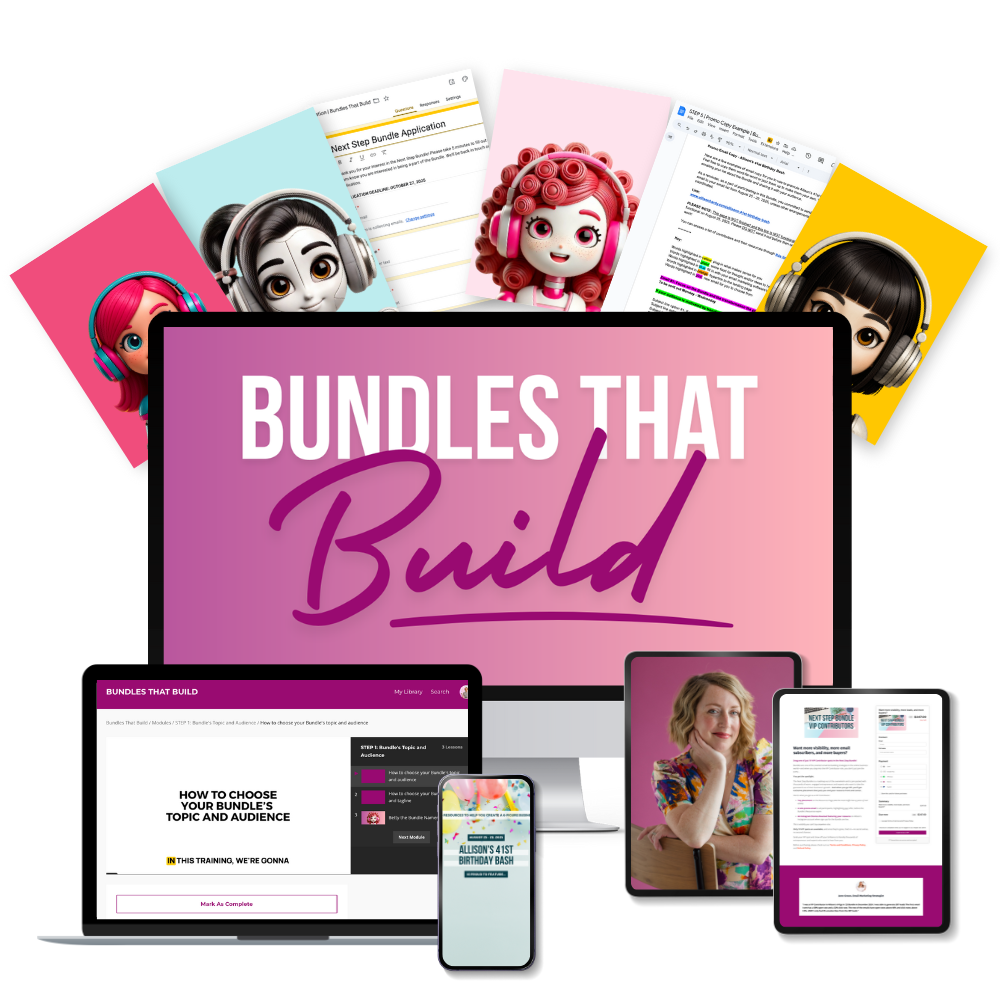
Host a bundle that builds your email list, your visibility, and your sales.
Transcript:
Today we are digging into session number three and we're gonna be talking about the thing that everyone thinks they need to create sales, but they actually don't. And it's your pitch sequence. And you know that because you listened to yesterday's funnel fix session. And you know, in session two we talked about how. The nurture sequence actually sells your program. Okay, so we're gonna talk about still why we need a pitch sequence and what needs to go into your pitch sequence to make a high converting email funnel. And when I say high converting, I mean one that actually sells, right? That's the whole point of this.
So we're gonna talk about how to sell to the seven different buyer types that you have in your audience. Who are actually reading your emails. So this is the last part of my VIP week process By the time your email subscribers enter into your pitch sequence, they should already be sold. They're sold on your ideas, your thoughts, your methodology, that you are the person to help them. The pitch sequence is the part of the email funnel that makes the invitation to buy from you. It drops the link and it says, Hey, you have this awesome offer. It's available for the next five days. Join now. And it makes that invitation to join your program official. And so when I'm saying the word program here, guys, this is probably one of the number one questions I get. What do you mean by. Program, I'm talking about your course, your membership, your group coaching program, even like your digital products, the things that you sell, okay? The things that you sell for money.
So high converting, high selling pitch sequences. Speak to the seven different buyer types that you have in your audience. And before you say, I don't have seven different biotypes, I know for a fact that you do. I developed this methodology after. Digging into the different buying habits that different buyers have. Each buying type has a different limiting belief. They have a different objection. They have a different kind of methodology in buying. And so I'm gonna show you these emails. I'm gonna tell you the order. These emails need to go in because I have them placed this way because certain people need certain things at certain times. And so when we're speaking to only one buyer type. We're leaving all those six bio types on the table and we're not addressing. Their limiting beliefs, their objectives, the way they buy, their reasons they buy. So while you may not have a lot of one buyer type, this process, I'm gonna walk you through this order is really important because we need to deliver this type of buyer type here, this type of buyer type here, this type of buyer type next to make your pitch sequence super, super, super successful.
All right, so pitch sequence emails. What are they? Let's talk about the order. Let's talk about the buyer type and the type of email that goes with this buyer type. So the first email that gets sent out in your pitch sequence is for the no frills buyer. And guys, I am a no frills buyer, so I don't need a lot of information from you to buy. If I am in your email funnel, I've intentionally put myself in there because I know I wanna buy from you. Okay, so I don't need to know how many calls do I get? I don't need to know when does the program start. I don't even really care. I don't need to know client stories. If I've already placed myself into that funnel, I've already done that research, I just wanna know what's the offer, how long do I have to buy, and where's the link? So the to the point, email is not fancy at all. It's very simple. It's, here's the promise of the program, here's what we do in the program. Maybe here's like a couple of deliverables and like you have five days to get your a hundred dollars discount, whatever. So this is the first email in your pitch sequence because these people again, don't need a lot to buy from you. They're already probably like. 95% of the way sold. I'm a no-frills buyer. If I were to speak to the no-frills buyers, only in my pitch sequence. I would not make any sales because I actually don't have a lot of no frills buyers in my audience, even though I am one. And again, I know that because I've tracked this information. Okay. So this also can be really helpful in understanding more of the type of buyer that you have in your audience.
Okay. So the next email you need to write is for the details buyer. So this person is the exact opposite from the No Frills buyer. They wanna know how many calls do I get? They wanna know when does the program start. They wanna know where the client stories, they wanna know all those details. And guys. I cannot relate to these folks at all. So whenever I write an email for this person, I send it to my colleagues who are details buyers, and I'm like, Hey, I need, I need you. Can you, can you please review? So the FAQ email here is for the details buyer. The FAQ email answers all the questions that you're getting. Very often. The thing I want you to remember is whenever you're answering a question. You're actually debunking an objection.
So let's use an example here. Let's say that a lot of your questions revolve around like time, like how many hours should I expect to spend on your program in a week? So you're gonna answer the question of course, but then like ask yourself why. Why is this a common question that your audience has? Do you work with people who they've got a lot of little kids at home or they're stay at home moms, or they homeschool, or maybe they're taking care of aging parents or they work a nine to five. What's the objection there? What's going on in their life where time is a concern? And so when you're answering this question, yes, you're gonna answer the question, but you're also gonna say like, Hey, I actually have this tool inside this program, and it's gonna help you take something that would've spent, that you would've spent five hours on and get it up and running in one hour, or whatever the thing is, right? Show them how you're gonna speed up their time by enrolling in your program.
The next email we have is for the skeptical buyer. After 2020 when everyone came into the online space there was a lot of sketchy things going on. A lot of people promise things that they never delivered on. A lot of people took people's money and ghosted. And now we're also seeing a bit more of the skeptical buyer rise because of AI and people's distrust and things like that. People generally are more skeptical than they were prior to 2020 for sure. So skeptical buyers need to know, have real people actually done this thing and achieved results. And what I want you to keep in mind here is this client story email. You're talking about where this person was before they joined your program, why they joined your program. And the results that they saw. We do not need, the skeptical buyer actually doesn't want those super sexy client stories we all have. They need to know what's like a normal run of the mill testimonial. What is a normal, average result? Because that is going to lower the resistance level if you're sharing right outta the bat that client story where they just hit it outta the park. That's just gonna build a wall up higher. They do not wanna know that information. They wanna know any normal run of the mill testimonial. After you've shared maybe a couple client stories, then yeah, you can share that awesome story. But those first couple of client story emails need to be normal run of the mill client stories. I have a lot of skeptical buyers in my audience, I think just 'cause of what I do. So in my email funnels, in my pitch sequences, I usually have more than one client story emails and they build upon one another. So first is like a normal one. Next one is kind of like, ah, okay, this person like kind of killed it. Next one is like this person like totally killed it. And then like the next one is like. This person sold 100 K of their course in 93 days through their email funnel. And I have that story. So I build upon it. So if you guys find that you have a lot of skeptical buyers in your audience and you wanna pepper your pitch sequence with more client stories.
Relational buyers. So relational buyers, wanna know more about you. Like what do you believe in, what do you like, what's your morning routine? Do you have kids? Do you like coffee? Do you like tea? Do you love a good glass of red wine after a hike sitting on a park bench? What is like the thing that like you love to do? And why did you start this crazy business of yours? Why do you do this? Why did you decide to do something that's really hard and start a business and become an expert in this space? What's your origin story? And so your likes can be woven throughout that, but they're relational buyer needs and information, not because they're looking to be like, yeah, same. Like I get it. Like I'm, I'm the exact same way. They just wanna know more about you. And so while they are making the decisions based on the thing that you do, they're more likely to buy from you because they know you rather than like buy basically the same thing from someone else if they don't know. Okay, so your story, you are gonna share your story in this email. And if you're like, I don't have a big like, come to Jesus story, that's okay. Most people don't. I hear this objection a lot. Your story can be just a simple story about you, your life, your business, and why you love what you do. So don't overthink it. I think this is one of the emails that gets really, really over thunk, thunk, thinked. Thought through. I don't know. You know what I'm trying to say. All right.
The next email is the invitational buyer. So these people just need to be asked, Hey, do you want this? While they can hit reply and buy and ask questions from any email, they need you to explicitly say this to them. And this one was a really hard one for me to wrap my head around when I first started doing this work. And I was like, it's so obvious. Anyone can just hit reply and ask questions, but unless you invite these people explicitly to do it, they're never going to do it.
So I remember when I first started doing this work, I had, um. This. It was back like a while ago. It was when Facebook Live just came out, so this is going to age me right? Like 2015, somewhere around there. It was when Facebook Live first came out, we were all living over in Periscope doing these like live streams. And then Facebook Live was like, oh my gosh, we're to come out to kill Periscope. And sure enough they did. But when we used to do Facebook Lives. We would get crazy traction, right? Especially from our business pages. And I found it very easy. Like I was very much so, like this is very easy for me to do. I was a personal trainer at the time. I would have these like strange blocks of time in between like my morning and my lunchtime workouts with clients. And so I would just be like hanging out at the gym. And so I started to do these Facebook Lives 'cause I was like, I am so bored. I need to do this work anyways. So like let's just do it. So I started this like. Facebook live series every day at 9:00 AM after I was done training my, like early bird training, clients. So I got really good at it and it was really easy for me to sell through. And I booked clients regularly through it and people started to ask me like, can you teach me how to do this? So I created a group coaching program. And this was back when Facebook Live was only on your phone, right? There was no desktop interlay or anything like that. It was all on your phone. And so I'm doing all these Facebook lives, I'm doing this like live stream event. On Facebook live through my phone, and when I sent this email out, someone actually emailed me like, what equipment do I need? And I thought it was so incredibly obvious, right? I'm doing it on my phone. We have no other options except to do it on our phone. But for her, it was the thing that was in the way of saying yes. So as soon as I was able to answer that question, she bought within like 10 minutes. So this email is simply to ask. Do you have any questions? She paid me $2,500, like on the spot after I just said, no, you don't need anything, you just need your phone. So like this email may seem so incredibly simple to you. It may seem like such a small question that's getting sent to you, or such an obvious question that's getting sent to you. But for that person on the other end of the screen. It is the thing that is holding them back. So do not be afraid to ask your people questions. Hey, do you have any questions? Hey, what concerns do you have about the program? Hey, like, what do you need to know in order to say yes?
The 1, 2, 3, 4, 5, 6 email we have is the struggling buyer. So this one is the person that has the pain point. They identify having the pain point. They wanna solve it. They've probably tried to solve it and have failed, and so they are kind of in this cycle of like. Should I try this new methodology? Is this person for me? Can the, is this right for me? Like they're kind of like cycling, right? So the pain point email calls out the pain points, and I know that a lot of people have resistance to writing pain point emails. I am not talking about the type of pain point email that's like stab 'em with a knife and turn it and make him really feel a pain. We're not doing that. We're simply just acknowledging it. Hey, I know this is frustrating. Hey, I know this is what you're experiencing. Hey, I know that you're done with this, but like you don't know what else to do. The pain point email helps these people to feel seen and heard and understood. And when someone who is struggling seals feels seen and heard and understood, they're way more likely to buy. I work with a client, she's a GLP one coach, and this is like her main, like focus in her business is helping folks. Who have struggled with weight loss for years and years and years and like their entire lifetime understanding that she gets it and she understands it. And so she does a lot of like sharing her story because she is her own ideal client. She does a lot of acknowledgement and like work around like I get it. I hear you. I understand. Yes, this is hard. And like she is such an empathetic, sympathetic person, but like for her, the relational. And the struggling buyer, those are her two people. So she goes back and forth inside of her pitch sequence, mostly between those two types of buyers. She has the other buyers, yes. But like for her, like this is like what she needs to do and what she needs to say in order to get people to understand that she can help them. And then when they're in, they're in and they see results and they're like so happy. But it's that sort of, you know, approach to her pitch sequence. All right.
The last biotype we have is an aspirational buyer. Okay, so these are the same as the struggling buyers. They have the pain point. They know they have the pain point. They want to solve it. They've tried to solve it, they have failed. They're looking for options for other ways to solve it. However. They're not motivated by solving the pain point, like the struggling buyer is. They are motivated by what's possible through solving the pain point, so they are very much so interested in aspirational phrases. What's possible. So that phrase is like, do this so that you can do this. And they love a pleasure point email. So they love talking about outcomes. They love talking about transformations. That is the stuff that motivates them. These people also happen to be. Procrastinators most of the time I've discovered. So we pair this email at the very end because when you can come and say you do these things so that you can do this, whatever that outcome is, oh, and by the way, you have four hours left to join if you want this offer. The aspirational buyers tend to be a bit of procrastinators for sure. They are very similar to the struggling buyer, the people who have the pain points, but they need to talk about the outcomes.
So that's your pitch sequence. Okay. That's the order they need to be in. Sorry. If you have a lot of one type of buyer, you may need to pepper in more of one type of email and you can tell if you have more than one type of buyer because you're going to ask your buyers questions. You are gonna see where they came off, like how they, what email they came into your program through. And then when they onboard, you're gonna have a survey and you're gonna ask them questions about their buying habits so you can get that data. So that you can write more of these emails that speak to more of those concerns and you can sell more of your course, your program, your digital product, your membership, whatever the thing is that you sell.