Listen to the podcast on:


Join the LIVE Masterclass on October 28 at 1:00 pm ET!
Sell on Autopilot Masterclass
Use email marketing to sell while you sleep
(or, ‘ya know…live your actual life!)
How to Use Testimonials in Your Emails (So People Actually Read Them)
Let’s be honest about what happens when a “Client Love” graphic shows up in your feed.
Pretty template. Brand colors. A big block of text.
And you scroll right past it.
If you’re skipping other people’s testimonials, your audience is probably skipping yours.
Why Nobody Reads Your Testimonials
In this Empire Exclusive episode of the Email Empire Podcast, I sat down with Jenna Harding, a marketing coach and the host of the Shiny New Clients Podcast. Through her program, Magic Marketing Machine, she simplifies Instagram marketing and teaches small business owners and freelancers how to grow on Instagram and turn their followers into clients.
Jenna is sneakily good at testimonials, and she thinks about them differently than most of us do.
The graphics aren’t useless. Your brain sees one and thinks, “Great, they’re good at what they do.” But if someone never reads it, they never see their own situation in it.
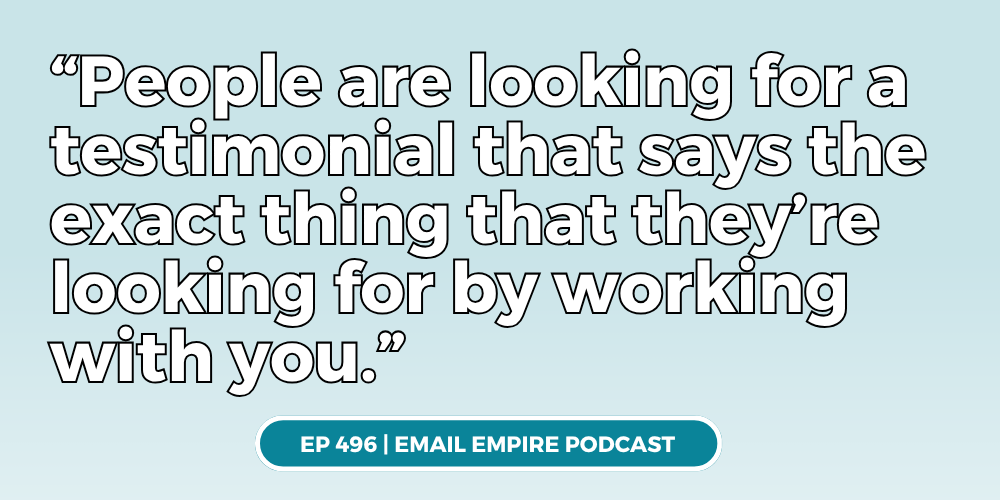
“People are looking for a testimonial that says the exact thing that they’re looking for by working with you.”
— Jenna Harding
Your potential customers aren’t looking for praise. They’re looking for proof that it worked for someone like them.
Use One Line, Not the Whole Block
Say you’re writing an email to make a point. You tell your story, but your reader still has to take your word for it.
Jenna’s fix is to slide in one line from a client that proves the exact thing you just said. Not the whole testimonial, just the sentence that backs you up.
It works in:
Emails: drop the line in right after the point you’re making
Sales pages: put a screenshot beside the part of the offer it supports
Social posts: tack a quote onto the end of a post or carousel
And yes, it’s hard to cut the part where a client says you’re lovely and hilarious. But that part isn’t what convinces the reader.
Collect Testimonials in Unlikely Places
Some of the best testimonials already exist, and you didn’t ask for them.
Jenna saves screenshots of emails, comments, and DMs where someone pays her a compliment, then sorts them so she can find them later. When someone compliments you off the cuff, it’s usually shorter and more specific than a testimonial you formally asked for.
She tags hers by topic: easy, fast, made money. When she’s writing a post about how easy her method is, she searches “easy” and picks the best ones.
You don’t need hundreds. Start saving them now and the system builds itself.
(Quick note from Jenna: Rules around sharing testimonials vary by state, province, and country, so look up what applies to you and do it by the book.)
How to Ask for a Testimonial Without Making It Awkward
Most clients don’t know what makes a good testimonial, and they’re busy and a little nervous, so you get “She’s great!”
Jenna’s approach is to make it easy:
Ask if they’re willing to share a testimonial.
Send a few questions for them to answer.
Write the testimonial for them.
Let them approve it.
Your client just has to answer four questions and give you their seal of approval.
You can do this with a simple email, or a Google or Airtable form. You can even automate it.
Jenna also recommends asking during the work instead of waiting until the end. Questions like:
How are things going?
What results have you gotten so far?
What was the thing you least expected?
What were you nervous about going in that turned out to be fine?
That last question is gold. It gets you a testimonial like, “I was scared to work with Allison because I thought I was a bad writer. But now I see that anybody can write emails that sell.” Every reader who thinks “I’m a bad writer” now sees themselves in it.
Try a Case Study Carousel on Social
Jenna loves a case study carousel:
Start with a hook about the viewer, like “Five things to double-check in your email marketing settings right now.”
Tell a client’s story, what was wrong and what changed.
End with the testimonial as proof it happened.
The post is about the viewer’s problem and a real person’s result, instead of a block of text about you.
What Happens When People See Themselves in Your Proof
Jenna shared two examples:
A client who watched her webinar saw a testimonial from another acting coach, thought, “It worked for them, it’ll work for me,” and signed up for her program.
Jenna herself once enrolled in a high-end mastermind because a testimonial said, “I only had 20 hours a week to work,” and she thought, “Yeah, same.”
The right sentence can be the thing that makes someone hit buy.
Where to Start
You don’t need a system to begin.
Finished a sales post? Add three dots and one quote at the end.
Made a carousel? Add a testimonial slide.
Halfway through an email? Say, “This is exactly what happened to my client Susan. Here’s what she said.”
Challenge yourself to add two more pieces of social proof to your emails, social posts, or sales pages this week. You can tack them on even after you’ve finished writing.
The Big Takeaway
Testimonials work when readers see themselves in them.
Stop dumping a block of praise on people. Use the one line that proves the point you’re making, make it easy for clients to give you specific feedback, and put it where your audience is already reading.
Listen to this episode for Jenna’s full approach, including how she organizes her testimonials and what she asks clients.

Join the LIVE Masterclass on October 28 at 1:00 pm ET!
Sell on Autopilot Masterclass
Use email marketing to sell while you sleep
(or, ‘ya know…live your actual life!)
Frequently Asked Questions:
Q1: How do I use testimonials in emails?
A1: Instead of pasting a full testimonial, pull one sentence that proves the point you just made in your email and include it right after that point.
Q2: How do I get more specific testimonials from clients?
A2: Make it easy. Ask a few targeted questions, write the testimonial for the client, and have them approve it. Asking midway through your work together often gets better answers than waiting until the end.
Q3: Where else can I use testimonials besides emails?
A3: Anywhere your audience reads: social posts, case study carousels, sales pages, and webinars.
Q4: Where can I find testimonials I didn’t ask for?
A4: Look at emails, comments, and DMs where clients have already complimented you. Screenshot, sort, and save them so you can find the right one later.
🔗 LINKS MENTIONED:
🎟️→ Testimonials That Sell
🌐→ Jenna’s Website
📲→ Jenna's Instagram
💰→ Sell on Autopilot Masterclass
📲→ Allison's Instagram
🤔 Want to work together?
Here’s how to get started!

Join the email marketing membership for coaches and experts, who want to sell their offer on autopilot.
Host a bundle that builds your email list, your visibility, and your sales.