EP 494 | One Tiny Email Setting Increased Open Rates by Nearly 20 Percentage Points
Listen to the podcast on:


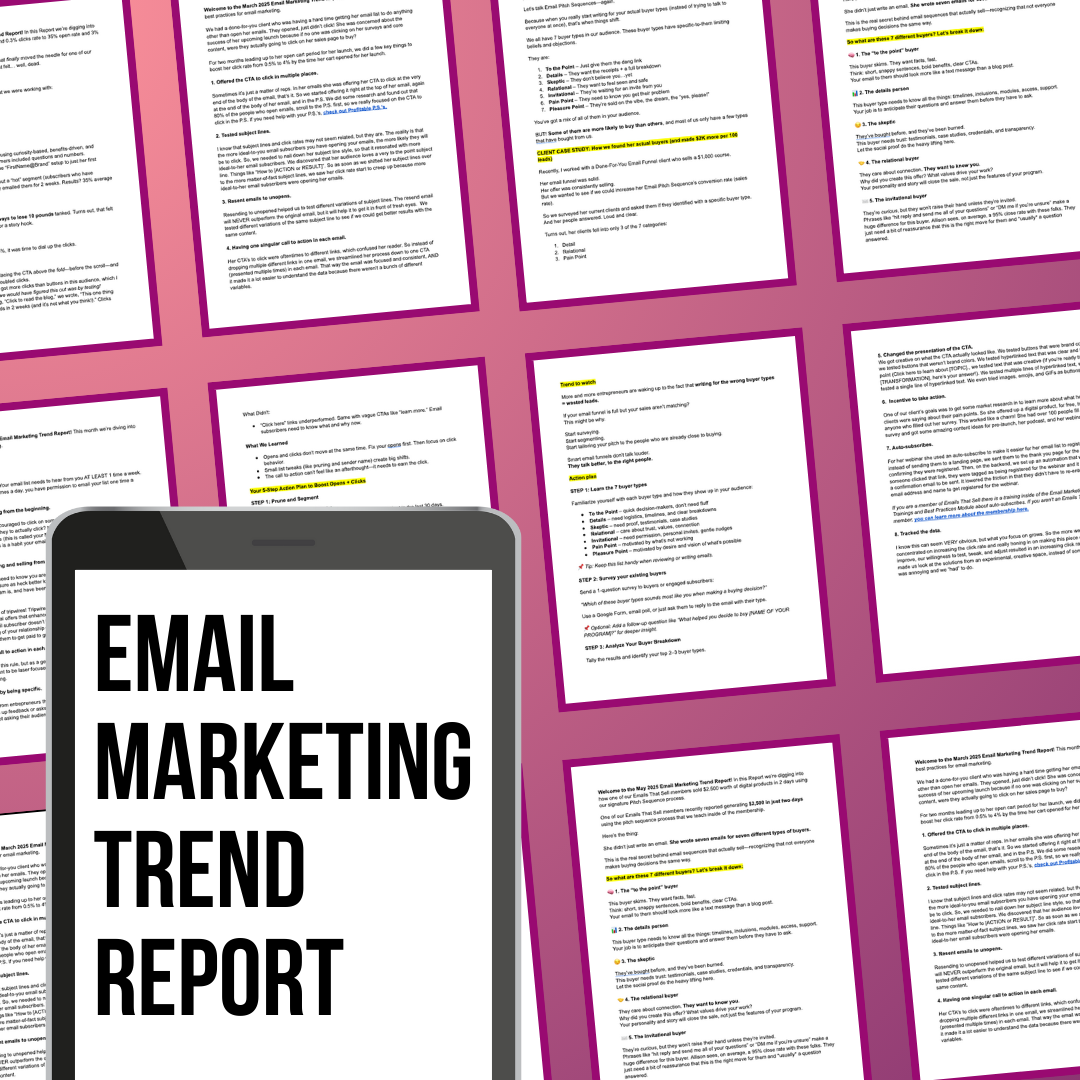
Want more behind-the-scenes email marketing experiments like this? Subscribe to the Email Marketing Trend Report for $7/month and get real data, real tests, and actionable strategies you can use to improve clicks, conversions, and sales.
Sometimes your email problem is not your subject line.
It’s not your copy. It’s not your offer. Sometimes your brand-new subscriber simply has no freaking clue who you are yet.
And that became very obvious when we looked at one of my done-for-you client’s Nurture Sequences.
Her lead magnet delivery email was performing beautifully. Then Email Number Two showed up 24 hours later and the numbers absolutely tanked.
The problem wasn’t that people had forgotten what they signed up for.
They had forgotten who was sending the email.
And one tiny change helped increase the open rate on that second email by nearly 20 percentage points.
Your new subscriber is not experiencing your business the way you are
When someone joins your email list, it’s really easy to think:
Great. New subscriber. They’re in my world now.
But that person is probably not sitting in their inbox thinking:
I’m so excited to officially enter this person’s email marketing ecosystem.
They wanted the thing you’d offered. (The template. The checklist. The quiz. The Bundle. The Masterclass.) The lead magnet that solved the problem they were thinking about approximately 90 seconds ago.
They recognize the resource before they recognize you.
The first email has a massive advantage
The first email someone receives after opting in usually performs really well. Of course it does! They just gave you their email address and asked you to send them something. They are actively looking for it.
For this particular client, that first email was seeing around an 80% open rate and a 50% click rate.
Then the second email arrived and suddenly the open rate dropped dramatically. We were also seeing more unsubscribes and spam complaints.
That told us there was some kind of disconnect happening. The subscriber clearly remembered downloading the resource. What they didn’t necessarily remember was the name of the person who created it. So we tested something incredibly simple.
What if the sender name was the thing they already recognized?
Instead of sending the first few emails from my client’s personal name, we changed the visible sender name to the name of the lead magnet.
Same email address. Same sending domain. Same sequence. Same copy. We changed the name showing up in the inbox.
And the second email’s open rate went from 32% to 49%. That’s a 17-percentage-point increase.
Then we tested the same idea with a JV Masterclass. When my client’s personal name was the sender, the second email had a 37% open rate. When we used the name of the Masterclass instead the open rate went up to 59%. That’s a 22-percentage-point increase.
Across the tests, the average open rate on that second email moved from about 39% to about 59%.
All because the sender name connected the email back to something the subscriber already remembered.
Recognition comes before relationship
There’s a bigger lesson here than sender names.
We tend to overestimate how much awareness a brand-new subscriber has of us.
You may have spent five years building your business.
Your existing audience knows your name.
Your clients know your name.
You have a podcast, a website, a newsletter, offers, frameworks, and a whole ecosystem built around your work.
But someone who just downloaded your lead magnet just met you 90 seconds ago.
There is a big difference between: “I recognize this email.”
and
“I recognize this person.”
The first can happen immediately, the second takes time.
Using the resource name as the sender name can create a bridge between those two things. And this is how the relationship starts forming.
This does not mean your lead magnet should become your new identity
I would not keep sending from the name of your lead magnet forever.
The point is not to hide behind the resource. The point is to use familiarity strategically while your subscriber is still learning who you are.
You could test something like:
Emails 1–2: Resource name
Email 3: Your Name from Resource Name
Email 4 and beyond: Your Name
Now you’re gradually transferring the recognition they already have for the resource onto you.
And that is much different from assuming they already know who you are simply because they filled out your opt-in form.
Start with Email Number Two
If you decide to test this, I wouldn’t obsess over the delivery email. That first email already has strong intent behind it, your subscriber is expecting it.
The more interesting email is usually the next one because this is where the immediate excitement of downloading the resource has worn off. It’s where your sender name, subject line, and existing familiarity have to do more of the work.
Look at the second email after your biggest lead magnet and ask:
Would a brand-new subscriber immediately recognize the sender name they see in their inbox?
If the answer is no, you may have an experiment worth running.
And when you do, don’t just watch open rates. You should be tracking:
Click rate
Unsubscribes
Spam complaints
Replies
Overall engagement through the rest of the sequence
Because a higher open rate is useful. But a higher open rate paired with fewer complaints, more clicks, and more people staying engaged is much more meaningful.
the big takeaway
Your newest subscriber may recognize what they signed up for long before they recognize you.
That means part of your Nurture Sequence’s job is helping them connect those two things.
Your lead magnet gets them into your world.
Your follow-up emails help them understand whose world they just entered.
And sometimes, one tiny setting inside your email marketing software can make that connection a whole lot easier.
Want the actual tests behind strategies like this?
The Email Marketing Trend Report gives you a fresh, data-backed email marketing strategy every month based on what we’re seeing inside real campaigns.
It’s $7/month, and every Report breaks down what we tested, what happened, and what you can do with that information in your own business.
Frequently Asked Questions:
Q1: Does changing the sender name affect email deliverability?
A1: Changing the visible sender name is different from changing the email address or sending domain. In this test, the sending infrastructure stayed the same while only the name subscribers saw in their inbox changed.
Q2: Should I use my lead magnet name as my sender name forever?
A2: No. The goal is still to build recognition around your own name or brand. Using the resource name can help create familiarity during those first few emails while the subscriber is still connecting you to what they requested.
Q3: Which email should I test first?
A3: Start with the second email in your Nurture Sequence. The delivery email already benefits from strong intent because your subscriber is actively waiting for it. The second email is often where recognition starts to matter more.
Q4: What metrics should I track?
A4: Look beyond open rates. Track clicks, unsubscribes, spam complaints, replies, and overall engagement through the sequence so you can see whether the change is actually improving the subscriber experience.
🤔 Want to work together?
Here’s how to get started!

Join the email marketing membership for coaches and experts, who want to sell their offer on autopilot.
Host a bundle that builds your email list, your visibility, and your sales.